Any life sciences organization operating across national borders depends on political and regulatory decisions made beyond its reach and influence.
Can diagnostic tissue samples from multiple countries be run in central labs? In the event of disruptive conflict, which trial sites can stay open, recruit, and treat on schedule? Which manufacturing locations and transit pathways will keep a product off a tariff schedule? Even absent conflict, what patient-level data will support or undermine dossiers across different pricing and reimbursement negotiations? Will thoughtfully designed, multi-country launch strategies survive fluid Most Favored Nation requirements?
Specific geopolitical disruptions cannot be forecasted, but readiness can be designed. Most companies designed operating models for a more stable world. Their assumptions no longer hold.
The dependencies that made the industry efficient are now pressure points
For three decades, life sciences organizations built operating models around a permissive, frictionless, and borderless world. Procurement sourced on cost and quality alone. Clinical teams optimized trial footprints for speed, concentrating enrollment in the regions that recruited fastest. IT pooled data into unified global platforms built for scale, while commercial teams deployed centralized playbooks across markets with minimal adaptation. Each choice made sense under the conditions of the time. Today, those same dependencies create elevated exposure. A shock to one can unsettle launch sequences, trial timelines, and investment cases.
Emerging markets illustrate the challenge. Many multinational organizations-built part of their growth strategies around rising middle-class incomes, anticipated improvements in market access and coverage, and later-wave launches that extend product life. Those plans assumed a central global playbook could travel freely. Today, the same markets bring localization mandates, currency and payment risk, sanctions exposure, and pressure to align with one trading bloc or another. The growth opportunity remains, but the assumptions underpinning it need to be revisited.
Governmental treatment of industry dependences has also changed. Export controls, sanctions, tariffs, and public budgets are now instruments of industrial and pricing policy. In 2026, tariff relief on patented medicines was tied directly to pricing and onshoring commitments. Patents are not immune: compulsory licensing, once a rare last resort, has become an option that can quickly shape a negotiation. Local trials, manufacturing, and data hosting are becoming preconditions for market access, challenging the viability of a single global operating model.
These pressures arrive from multiple directions, and decoupling between dominant global trading blocs follows shifting trajectories. Middle powers are pursuing their own priorities, building self-reliance while bridging traditional divides to form new trade blocs. Policy change has also accelerated. Where established norms once gave policymakers, lobbyists, and industry stakeholders time to shape legislation through extended negotiations, governments now move faster to advance their objectives.
Meanwhile, private-sector innovation often outpaces governments' ability to respond. As restrictions on Chinese investment and partnerships shift, Chinese-originated novel molecular entities and downstream dealmaking continue to move forward.
Geopolitical pressures converge across the business
What holds true for a supplier, partner, or data flow today may not hold tomorrow. Drugmakers operating across competing geopolitical systems must account for that uncertainty in decisions ranging from individual indication launches to portfolio planning. Past patterns offer a less reliable guide to what comes next.
These pressures sit within a wider set of drivers, from state intervention and armed conflict to health crises, demographic change, and shifts in energy and resources. Figure 1 traces how those drivers reach the business. Although their origins differ, they converge around five consequences: trade volatility, labor and talent volatility, IP and data challenges, pricing challenges, and supply chain disruption.
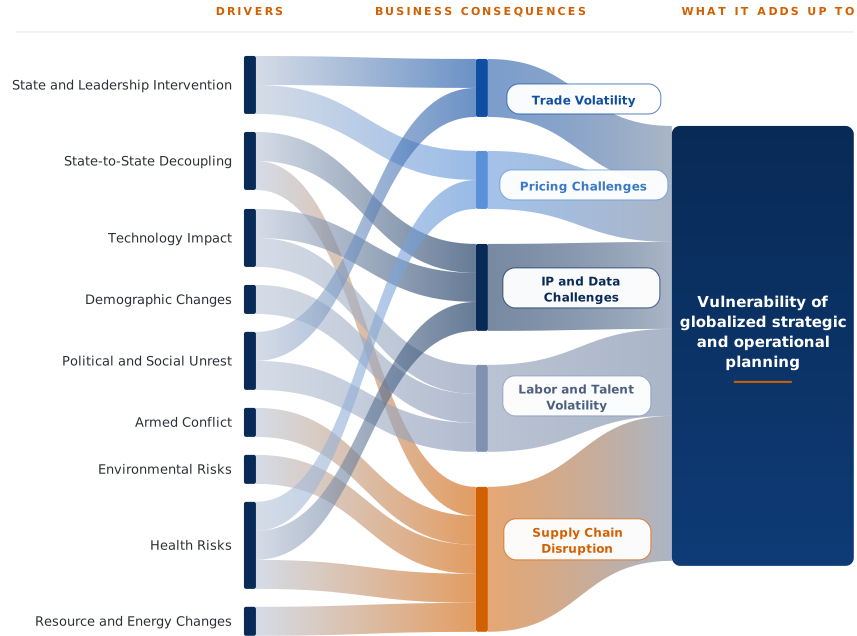
Figure 1: How geopolitical drivers collectively impact the business
These consequences are interconnected. Disruption in one area can trigger others because they depend on the same strategic and operational plan. The real exposure lies in their combined effect, which is easy to miss when each issue is managed within a different function.
One condition, felt in pieces
Risk first surfaces in the function closest to it, so teams tend to manage exposure as a function-specific problem. Each sees its own vulnerabilities clearly but may miss how they connect to others. Viewed together, these exposures reveal a shared underlying condition. As Table 1 illustrates, they often converge on the same countries, partners, and products.
| Function | Where exposure sits |
|---|
| Research & Development | Dependency on critical-path investigator clusters and centers of excellence
Imbalanced reliance on regional and local CROs
IP and data-sharing friction with academic partners |
| Clinical operations | Enrollment concentrated in a few regions
Sanctions- or conflict-driven site closures, with risks to patient safety and data integrity
Payment and currency risk, local quality and compliance risks, and variable diagnostic and monitoring vendor performance |
| Medical Affairs | Sanctions restricting engagement with scientific experts in some geographies
Diverging evidence expectations across regulatory blocs
Declining public trust in scientific communication |
| Regulatory | Persistent divergence between FDA, EMA, and NMPA expectations, including whether trial data from another region is accepted
Compulsory licensing precedents that add uncertainty to IP protection |
| Pricing and access | Rapid changes in local access and reimbursement requirements
Tariff relief tied to most-favored-nation (MFN) pricing
International reference pricing that carries a concession from one market into others
Source: Presidential proclamation under Section 232 of the Trade Expansion Act, April 2, 2026. |
| Supply chain | Single-source active pharmaceutical ingredients (APIs) and precursor materials
Tariff exposure determined by substance origin, transit routes, and other supply arrangements |
| AI, data, and innovation | Restrictions on cross-border genomic, clinical, and real-world data pooling
AI chip export controls and regional health data platforms that set their own terms for AI use
Diverging AI and data privacy regulations, including GDPR in the EU, the decentralized framework in the U.S., and LGPD and emerging laws across Latin America
State-sponsored theft of research data and intellectual property
Sources: 28 CFR Part 202, implementing Executive Order 14117; U.S. Department of Commerce, Bureau of Industry and Security, advanced computing rules (October 2022 and October 2023); EU AI Act, Regulation (EU) 2024/1689; and Osborne Clarke on the EHDS and AI Act. |
| Technology and talent | Hyperscaler services with uneven availability by jurisdiction
Cyber risk to research systems
Mobility limits and talent migration between trade blocs |
Table 1: Where exposure sits, by function
These exposures compound. A tariff decision can change the manufacturing footprint, which affects regulatory filings and launch sequencing, ultimately changing pricing. A function-by-function view misses the downstream effects of the initial decision.
AI and data: where the fault lines meet
AI and data make these dependencies particularly visible because a single dataset or model can span R&D, clinical, regulatory, and IT functions. AI in biopharma creates value when it runs on large, well-governed datasets and reliable compute. Both now sit within geopolitics. Most AI strategies account for whether data is clean and usable. Far fewer account for whether it is legally accessible or portable.
Data is being fenced by jurisdiction. Since April 2025, a U.S. Department of Justice rule has restricted access by countries of concern, including China, to bulk human genomic data above a threshold of just over 100 U.S. persons. The rule also reaches de-identified data. China restricts the export of its own human genetic resources while allowing significantly broader pooling and cross-analysis of patient data domestically. Europe, meanwhile, is building its own health data infrastructure under its own rules. A genomic or real-world dataset assembled from several regions may no longer be usable as a unified set, and a model trained on it may not be transferable to every market where it is needed.
Compute and models follow the same lines. Export controls govern who can buy advanced chips. Cloud regions and AI services are not equally available in every jurisdiction, and some markets expect sovereign platforms or local partners for health data. The AI vendor selected today carries the geopolitical exposure of the jurisdiction behind it. Rules governing AI also diverge across countries; the U.S., EU, and China are regulating AI on different timelines and with different assumptions. Countries that typically align with a broader regulatory body have begun to diverge, increasing complexity and the need for multi-scenario planning. A model validated for a regulated use in one market may require additional evidence, documentation, or retraining before it can be used in another.
Each of these exposures spans multiple functions, and none can be resolved within one alone. That raises a harder question: who sees the whole?
Existing coverage has its limitations
Most leadership teams believe this risk is already covered by government affairs, compliance, and supply chain risk management. Each provides a necessary capability, but each function typically operates within a defined remit. Individual teams may conduct scientific, regulatory, supply, or market-focused scenario planning. Integrated, cross-functional scenario planning remains rare.
Compliance owns sanctions; supply chain owns sourcing; regulatory owns approvals; and IT owns data residency. A single country can be a major enrollment geography, home to a critical contract manufacturer, and subject to new data-transfer limits at the same time. Each function sees part of the picture. The enterprise bears the combined exposure, but no one necessarily sees it in full.
The result is an episodic response. Each disruption is handled on its own terms: compliance updates a screening list, supply chain qualifies a second supplier, and government affairs manages the issue through communications, study, and outreach. Each response is reasonable in isolation. The problem arises when episodic response becomes the default operating model, even as the conditions behind these events persist. Trade-offs that should be made once at the enterprise level get revisited by individual functions, often after the disruption has occurred. For small and midsized drugmakers, with fewer global resources, local teams, and government relationships to draw on, the gap is even wider.
Closing this gap requires enterprise-level ownership and decisions made before they are needed.
Building proactive resilience
Leadership teams often ask what will happen next. No one can reliably predict every development, and forecasts of specific events can quickly lose credibility. A more useful question is which outcomes the business can absorb, assessed by time horizon, severity, and the speed at which conditions can change. Scenario planning makes that question practical by testing outcomes leaders might otherwise dismiss before they occur.
Decide which exposures to carry
Answering that question requires a sequence of decisions. Every form of protection costs money, and a company that responds to every scenario with redundancy will price itself out of its own markets. The goal is to determine, at the enterprise level and across defined time horizons, which exposures to carry, mitigate, or exit. The cost of resilience then becomes a planning input alongside cost, quality, and speed.
Build the structure that makes those decisions stick
Those decisions hold only when the supporting structure is established before disruption occurs. Governance is the starting point: one geopolitical risk council with pre-agreed decision rights and a common country risk-tiering system used across functions. The council provides a forum to make and revisit carry, mitigate, and exit decisions. Shared risk tiers give every function a consistent view: a country rated high risk for supply carries the same rating when clinical, data, and pricing teams plan around it.
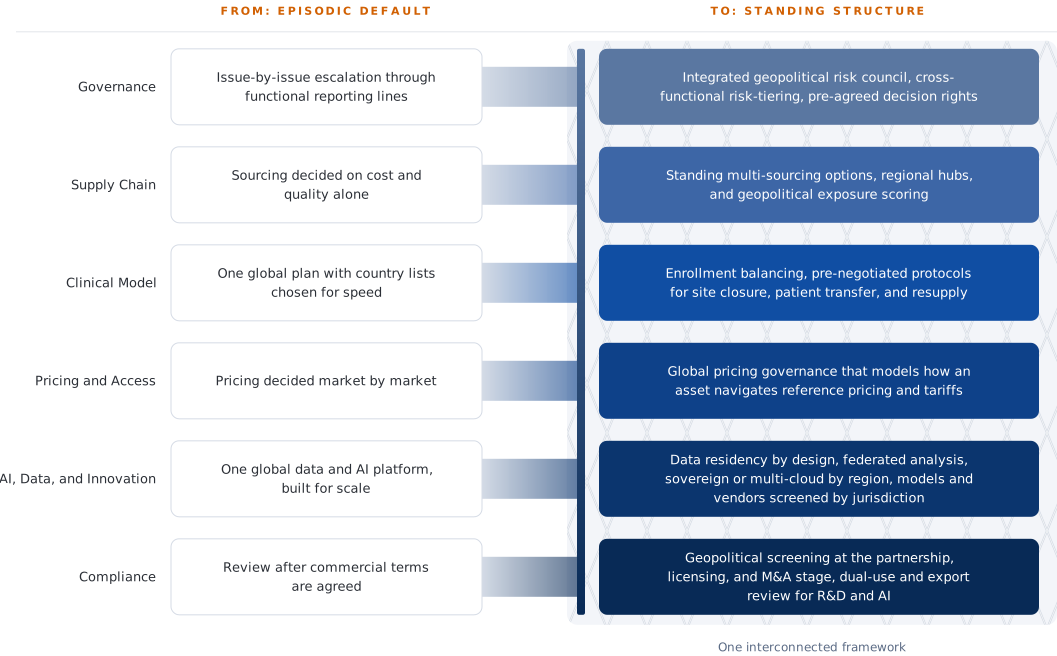
Figure 2: From episodic default to standing structure
The rest of the structure follows these decisions. Supply chain teams assess geopolitical exposure alongside cost and quality, protecting critical inputs through standing dual-sourcing arrangements and regional hubs. Clinical teams set enrollment caps by region and agree in advance on protocols for site closure, patient transfer, and resupply, so losing a country does not mean losing a trial. Pricing decisions move through global governance that models how a concession in one market affects reference pricing and tariff agreements elsewhere. Compliance teams screen partnerships, licensing arrangements, and M&A activity earlier, with dual-use and export reviews built into R&D and AI work.
Data and AI architecture decisions are now geopolitical decisions
Data and AI require early attention because their underlying architecture is difficult to change. Data residency by design, federated analysis, sovereign or multi-cloud infrastructure by region, and jurisdictional screening of models and vendors can replace the assumption that one global platform will serve every market. Decisions about where data resides, whether analysis moves to the data instead of data moving to a central repository, and which models and vendors enter the technology stack are harder to reverse than supplier choices. Companies building AI platforms today are establishing a footprint they may need to support for a decade.
Know where you stand
Resilience develops in stages, as Figure 3 illustrates. The maturity model tracks progress from reactive responses within individual functions toward an enterprise structure designed to absorb disruption. The greatest gains come when ownership shifts from individual functions to the enterprise as a whole.
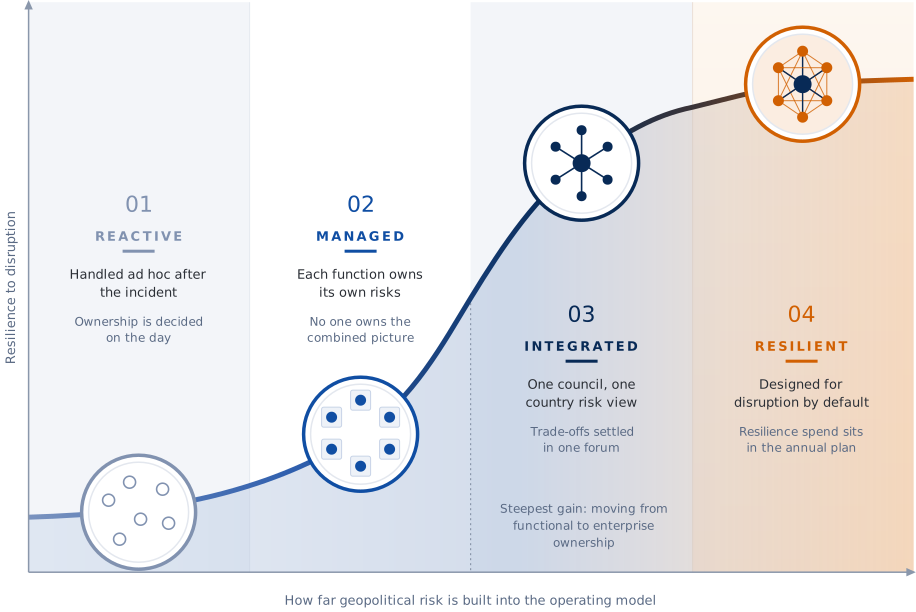
Figure 3: From reactive to resilient
The curve is steepest between the managed and integrated stages, where functional ownership becomes enterprise ownership. Most organizations will find that their functions sit at different stages. That variation is a useful starting point for identifying where the organization needs to build its capabilities first.
From plan to tested structure
Moving along the maturity curve requires more than identifying risks. Leadership teams need a shared view of their exposure, a way to make decisions across functions, and a plan for putting those decisions into practice. Acquis approaches this work in three steps:
Exposure mapping brings together the risks held across functions to show where they overlap and how they could affect the business. This establishes the combined view that a managed organization lacks.
Collaborative scenario gaming brings the affected functions together to test options and counter-responses, including scenarios leaders might prefer not to consider. This is where the enterprise makes carry, mitigate, and exit decisions with the relevant functions at the table.
A de-risking roadmap sequences the resulting mitigations, identifying the partners, resources, and decision rights needed to put them in place.
Fault lines will shift and pressure points will continue to emerge, but organizations can develop the resilience to pivot with confidence. By orchestrating a response that takes an enterprise-level view, companies can translate strategic decisions into an operating structure that teams can put to work before the next disruption arrives.
Acquis works with organizations to establish the governance and operational discipline behind the plan, test them under realistic pressure, and incorporate them into business planning and spending decisions. This is Acquis' Think+Do approach in action: integrated strategy and execution, delivered by operators and consultants embedded as one team, so an organization moves from plan to proven practice faster.