

Article
Beyond Geography: Dynamic Operating Models for Market Expansion and Portfolio Transitions
Geography is a good starting point, but building a Global-Local operating model is about much more than proximity.
Read More
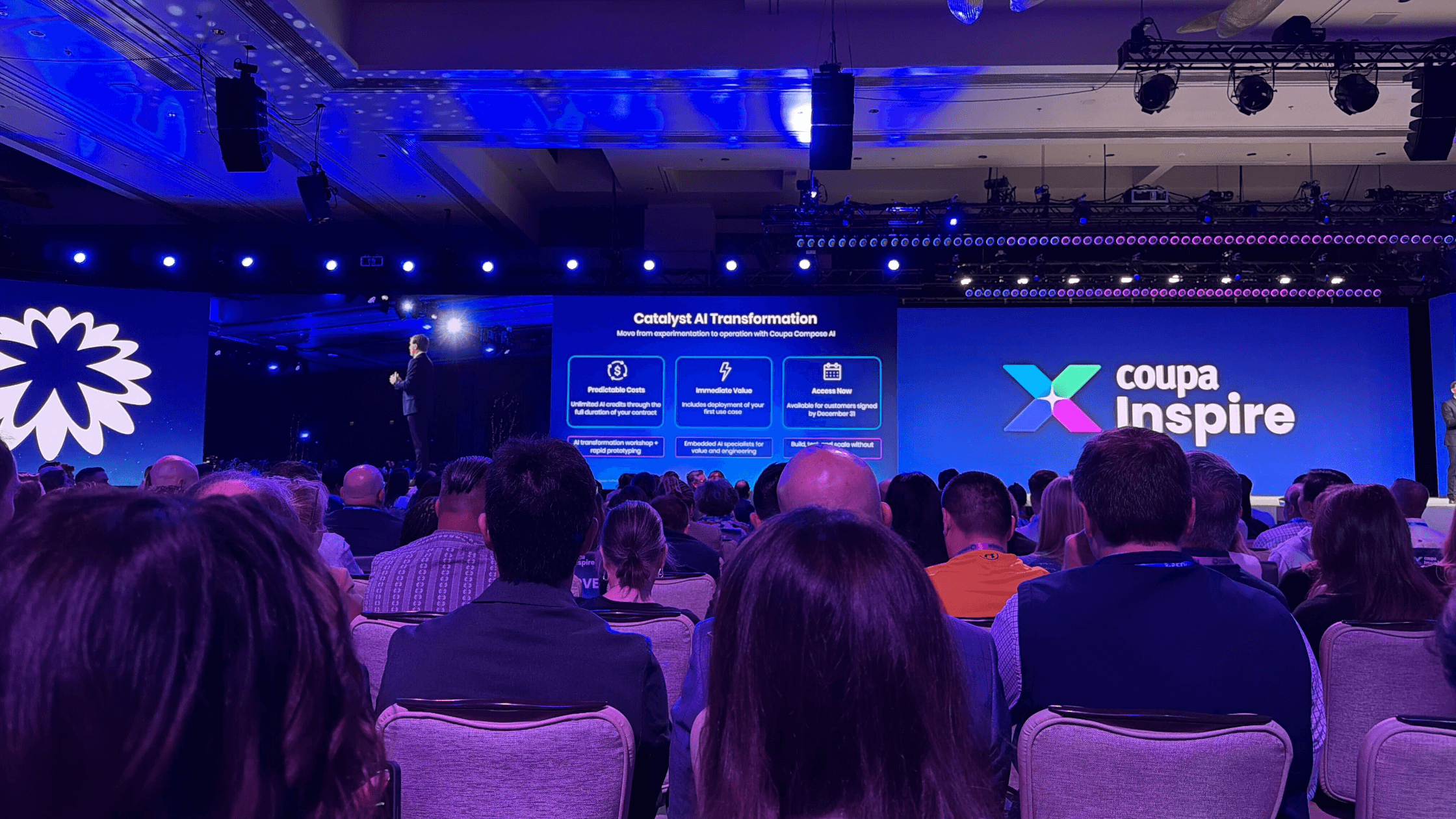
Coupa Inspire 2026 marked Coupa's 20th anniversary, and the conference reflected a company positioning itself for a new phase of growth. Coupa is building its roadmap around AI-enabled workflows, automation, and orchestration across the full spend lifecycle.
Coupa Inspire 2026 marked Coupa's 20th anniversary, and the conference reflected a company positioning itself for a new phase of growth. In her keynote address, CEO Leagh Turner shared that more than $10 trillion in cumulative spend has moved through the Coupa network, generating an estimated $300 billion in savings for customers. Turner also outlined the company's larger thesis for the future: embedded AI agents have the potential to materially increase the value organizations realize from the platform.
Coupa projects that organizations could eventually increase savings from the current range of $30 million to $40 million per $1 billion in spend to as much as $60 million to $80 million. Whether organizations achieve those outcomes will depend on adoption, process maturity, and execution, but the direction of the product strategy is clear. Coupa is building its roadmap around AI-enabled workflows, automation, and orchestration across the full spend lifecycle.
For years, organizations looking to automate work in Coupa faced a familiar limitation. They either waited for native functionality or built custom solutions outside the platform. Agent Studio changes that dynamic by allowing administrators to build and deploy AI agents directly within Coupa.
Scheduled execution is one of the most practical elements of the release. Administrators can configure agents to run on a cadence that aligns with operational needs, whether hourly, weekly, at month-end, or around specific spend events. That flexibility opens the door for teams to automate work that previously depended on manual reporting or reactive follow-up.
The use cases are immediate and operationally relevant. An agent can monitor purchase orders and notify requesters when available funds drop below a defined threshold. Another can identify agreements approaching expiration and prompt users to close or extend them before they disrupt purchasing activity. Others can surface unusual spend patterns, flag compliance risks, or monitor supplier activity without requiring teams to build recurring reports.
Coupa currently offers 20 prebuilt agents and expects that number to grow to 65 over the next two releases. Agent Studio takes this further by allowing procurement and finance teams to design automation around the operational friction points they understand best, instead of adapting their workflows to a predefined product roadmap.
During DevCon, the Acquis team built more than 10 agents over two days. Acquis will share additional guidance on the agents developed during the event — along with practical implementation considerations — in the coming weeks.
Agent Studio focuses on automating individual tasks. Orchestration extends that concept across entire workflows.
Previewed at DevCon and targeted for general availability in September 2026, orchestration allows organizations to connect multiple steps across procurement, supplier management, contracting, and compliance into a unified process flow.
Today, onboarding a new supplier often requires users to move between disconnected processes: supplier onboarding, contract creation, compliance review, and requisition setup each occur independently. Orchestration allows organizations to connect those activities into a coordinated workflow. The platform can evaluate whether a contract already exists, initiate one if needed, trigger compliance reviews through AI agents, and generate the purchase order once approvals and validations complete.
For many customers, this addresses a longstanding challenge with enterprise procurement technology. Organizations have historically adapted their processes to match how the platform operated. Orchestration moves Coupa closer to supporting workflows that reflect how businesses already run.
The design and functionality will likely continue evolving before general availability, but organizations should begin identifying which workflows would benefit most from orchestration now. Teams that establish those priorities early will move faster as the capability matures.
Invoice ingestion has remained one of the more frustrating areas within many Coupa environments, particularly for organizations processing large invoice volumes or working across inconsistent supplier formats. Coupa's acquisition of Rossum directly targets that challenge.
Rossum uses a transactional large language model to extract and digitize invoice data without relying on rigid templates. The platform supports a wide range of invoice structures and continuously improves through customer usage patterns. Rossum reports straight-through processing rates above 90%, which has made it a widely adopted solution among organizations looking to reduce manual AP effort.
The acquisition also reflects an existing relationship. Rossum has operated within the Coupa partner network for several years, making the move a logical extension of Coupa's broader push toward embedded automation.
Several questions remain open, including how Rossum functionality will ultimately integrate into the Coupa interface and what the transition path will look like for existing customers. Acquis will continue monitoring those developments as additional product details emerge.
Coupa also signaled a potential move away from traditional seat-based licensing toward value-based pricing.
The details remain limited, and many customer conversations at Inspire centered on questions around transparency and how value measurement will evolve alongside AI-enabled functionality. Organizations evaluating roadmap investments or long-term platform expansion should pay close attention as Coupa refines this model over the coming quarters.
At this stage, the direction matters more than the specifics. Coupa appears to be aligning pricing more closely with platform utilization and operational outcomes rather than user counts alone.
Beyond the product announcements, the most consistent theme across customer conversations centered on how much value current configurations leave on the table.
Many organizations implemented Coupa years before the platform's current AI capabilities existed. Their environments reflect workflows, governance structures, and operational assumptions that no longer match what the platform can support today. As a result, many teams now recognize that significant opportunity sits within their existing environments, untapped.
Conversations reflected that realization. Customers wanted to understand how to redesign processes around new capabilities, improve supplier and user experiences, deepen adoption, and reduce the operational workarounds that accumulated over time.
Those questions will define the next phase of value creation within Coupa environments. Agent Studio, orchestration, and the Rossum acquisition each increase the urgency for organizations to reevaluate how they run spend operations. Teams that actively redesign workflows around these capabilities will create operational advantages that compound over time. Organizations that simply layer new functionality onto outdated processes will struggle to realize the same return.
Acquis is developing practical guidance around Agent Studio adoption, orchestration readiness, and the evolving Rossum integration roadmap. Get in touch to discuss what these announcements mean for your Coupa strategy.
Subscribe to the Acquis newsletter
Tags:
Geography is a good starting point, but building a Global-Local operating model is about much more than proximity.
Read More

Combinations are not new. What is new is the velocity. The number of regimens pairing established immuno-oncology (IO) agents with novel molecules and mechanisms has grown significantly year over year, and the data supporting those pairings is maturing in ways that carry real implications for patients, drugmakers, and the broader life sciences investment thesis.
Read More

The May 2025 Most Favored Nation (MFN) executive order aims to align US drug pricing with the lowest prices paid by other developed nations. On the surface, it is a pricing policy. In practice, it is something more consequential.
Read More
Geography is a good starting point, but building a Global-Local operating model is about much more than proximity.
Read More
Combinations are not new. What is new is the velocity. The number of regimens pairing established immuno-oncology (IO) agents with novel molecules and mechanisms has grown significantly year over year, and the data supporting those pairings is maturing in ways that carry real implications for patients, drugmakers, and the broader life sciences investment thesis.
Read More
The May 2025 Most Favored Nation (MFN) executive order aims to align US drug pricing with the lowest prices paid by other developed nations. On the surface, it is a pricing policy. In practice, it is something more consequential.
Read More