For decades, technology implementation in life sciences followed a predictable path. Organizations documented the current state, defined a future state, and selected tools to enable that vision. Technology was viewed as an accelerator of human-designed processes.
AI does not fit neatly within that framework.
When a model can analyze thousands of historical protocols, benchmark against public datasets such as ClinicalTrials.gov, and propose optimized design elements in minutes, the question is no longer, "How do we use AI?" It becomes, "How must our work processes evolve to take full advantage of AI's possibilities?”
Whether you are seeking to optimize study design decisions, accelerate protocol development, select sites more strategically, expedite enrollment forecasting, or complete regulatory submissions faster, each area of focus requires a unique redesign of how work happens, with upstream and downstream implications.
What the redesign requires
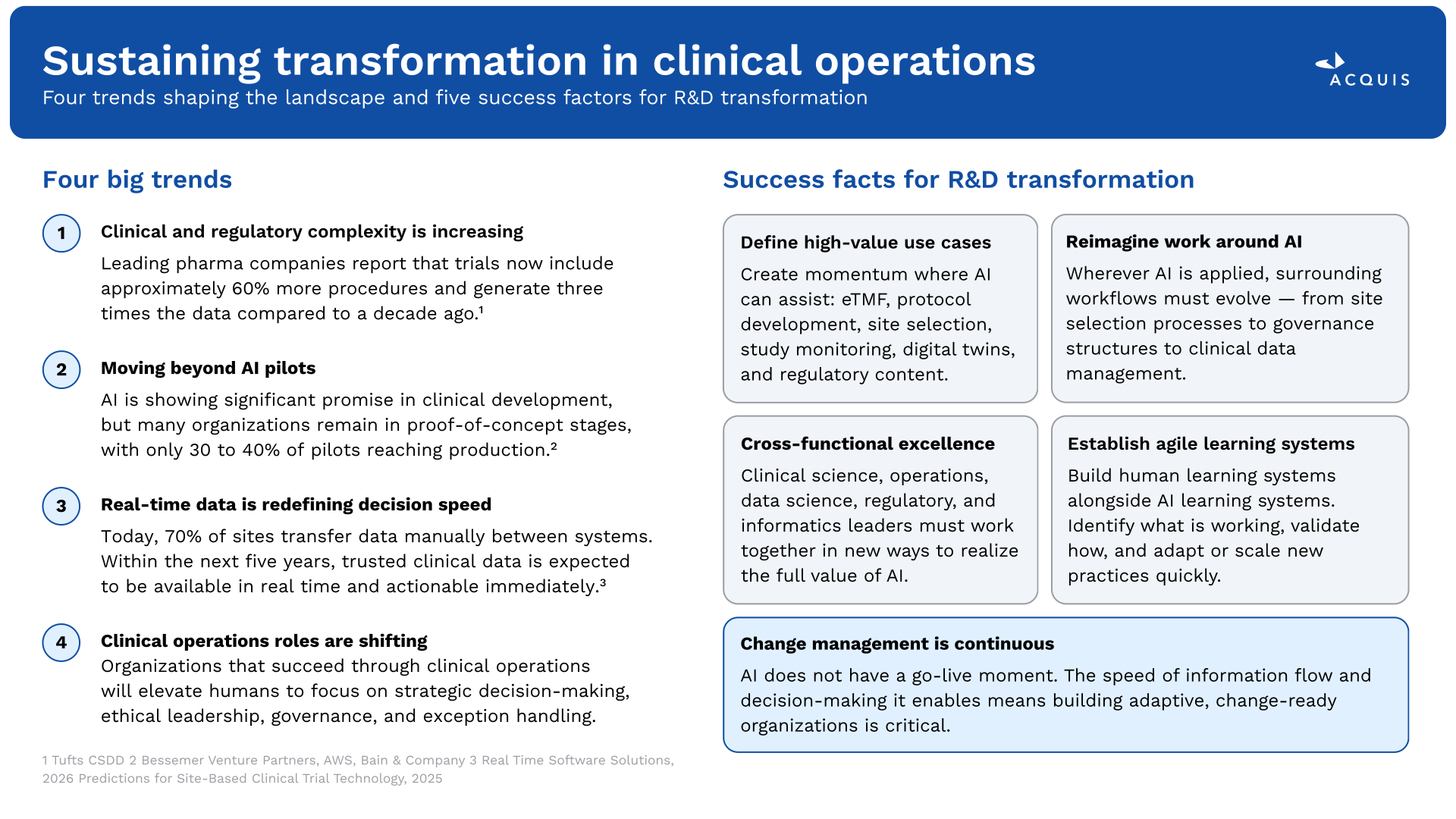
When AI demands operating model change, five dimensions define whether AI is embedded structurally or remains an overlay.
1. Role clarity between AI and humans
In organizations making meaningful progress, AI is not treated as an assistant layered onto established processes. It is treated as a coworker and assigned defined responsibilities within the decision architecture.
In study design, generative models can own first-pass protocol drafting, scenario testing, and historical benchmarking. Human experts then focus on adjudicating tradeoffs, applying scientific judgment, and resolving exceptions. The decision cycle changes because teams are no longer beginning from a blank page.
In portfolio oversight, agentic systems can continuously monitor trial performance signals across geographies and vendors, escalating emerging risks according to predefined thresholds. Leadership conversations shift from retrospective reporting to real-time and forward-looking intervention.
The key questions become: Where does AI act autonomously? Where does it escalate? Where is human judgment required?
2. Governance and decision rights
Access to AI-enabled capabilities has become ubiquitous. What differentiates organizations is how teams restructure decision rights, data flows, and business processes around AI models. Clinical resource management offers a clear illustration. Many clinical organizations continue to rely on decentralized, spreadsheet-driven capacity tracking. AI-powered tools can now provide real-time visibility into portfolio demand and functional utilization. However, if decision rights remain fragmented, governance cadence is unchanged, or internal or external teams operate under misaligned incentives, the benefits from improved visibility will not be realized.
The same principle applies when AI surfaces new information. If no formal decision rights or process have been defined around how to act on that information, the investment in AI-enabled insight is wasted. Governance redesign means defining who decides, how quickly, and on the basis of what inputs.
3. Compliance as a design constraint, not a retrofit
Treating compliance as a downstream checkpoint rather than an upstream design constraint is one of the most common reasons AI pilots stall at the threshold of scale.
Redesign must account for compliance from the outset. Auditability, data integrity, and regulatory expectations cannot be retrofitted. Governance, legal review, and change management must be integrated into the transformation process rather than treated as parallel tracks.
This is especially true as agentic systems take on more autonomous functions. When an AI system is escalating risks, flagging safety signals, or coordinating cross-functional workflows, the compliance framework must define not only what the system does, but also how its actions are reviewed, documented, and governed.
4. Infrastructure to enable innovation at scale
The efficiency promise of AI often begins with repeatable activities: contract analysis, document generation, and budget benchmarking. These are rational starting points and can deliver meaningful gains. But they represent the entry point, not the limit.
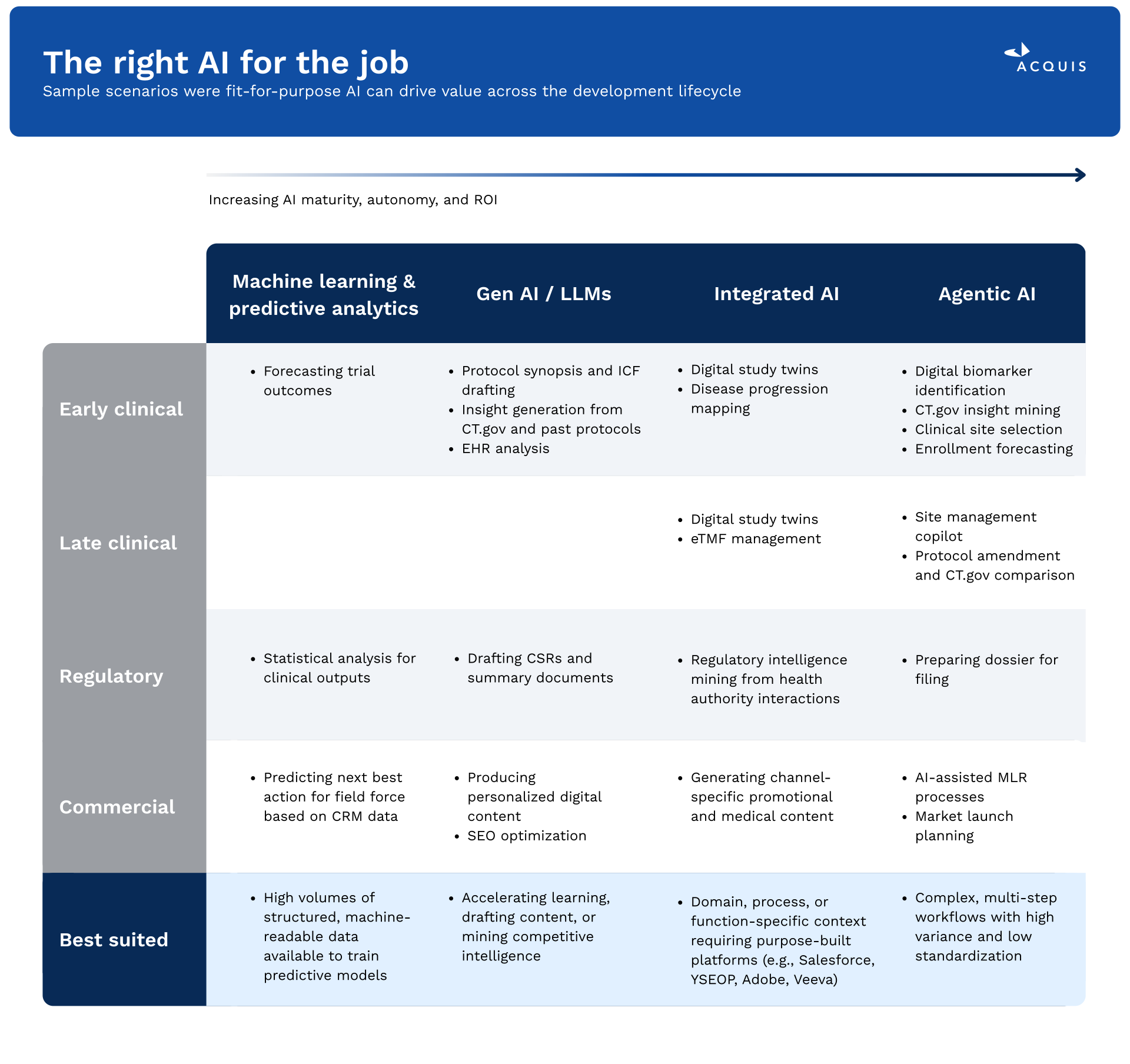
Large language models can synthesize insights from historical trial data to inform future study designs. Agentic systems applied to ongoing safety monitoring can detect emerging signals earlier than before. Scenario modeling can evaluate alternative resourcing strategies across a portfolio in real time. These applications augment human judgment rather than replace it; they expand the informational foundation on which decisions are made.
Realizing that value at an enterprise scale requires standardized data pipelines, integration across platforms, and operational readiness to absorb new ways of working. Innovation is no longer the bottleneck; it is the system required to deploy innovation reliably and repeatedly.
5. Continuous change management
Unlike traditional technology implementations, AI does not have a single go-live moment. The speed of information flow and decision-making that AI enables means the operating environment is continuously evolving.
Organizations that treat AI transformation as a standalone project with a defined endpoint will find processes outdated before fully adopted. Building adaptive, change-ready organizations requires establishing human learning systems alongside AI learning systems. The ability to answer what is working, how do we know, and what needs to adapt is critical. Without that feedback architecture, even well-designed operating models become rigid in the face of rapidly improving technology.
Where it compounds
The five dimensions above define the redesign. What follows is where that redesign pays the highest dividends.
Upstream decisions create downstream consequences
The decisions made early in clinical development — study design, site selection, enrollment forecasts, resourcing models — have compounding effects downstream. Get those opening moves right, and acceleration builds on itself. Get them wrong, and no amount of downstream optimization recovers the lost time and cost.
Most trial delays are rooted in execution rather than scientific uncertainty. Examples include site activation; data cleaning; and fragmented accountability across insourced, outsourced, and FSP hybrid models. When ownership is divided across entities and decision rights are unclear, misalignment compounds with every handoff. A meaningful acceleration target should be a 30 to 40 percent reduction in trial execution time. That target is achievable through foundational operating model work upstream rather than concentrated AI investment on downstream execution alone.
The bridge to launch begins earlier than expected
Launch readiness is frequently framed as a late-stage effort. In practice, it reflects years of early-stage decisions.
Competitive intelligence needs to be aggregated quickly and with precision, synthesizing market dynamics, payer landscapes, and competitive positioning into a coherent narrative that informs strategy in real time rather than in quarterly cycles. Operational readiness can move from static checklists to predictive models, powered by agentic systems, that flag risks to launch milestones and surface functional bottlenecks before they become critical. Resource and capacity modeling benefits from AI-driven scenario planning that enables teams to evaluate tradeoffs across field deployment, manufacturing scale-up, and market access sequencing simultaneously. Field enablement can be transformed through generative AI powering adaptive training modules that adjust to regional formulary dynamics and dynamic targeting and segmentation that evolves as pre-launch data matures.
Technology cannot compensate for fragmented governance. If commercial, regulatory, and development teams operate under misaligned structures, predictive insight will not translate into coordinated execution.
The operating model discipline that accelerates development underpins launch success.
The question that matters
AI is, in many respects, part of the answer. The models are improving. The capabilities are expanding. Investment will continue.
The key question is not whether to adopt AI, but what must change because of it.
What clinical or commercial outcomes are you seeking to accelerate, or which decisions are you looking to increase confidence around? Where do structural constraints inhibit acceleration? Which elements of governance, decision rights, and accountability must be redesigned to unlock what is now technically possible?
The life sciences industry does not lack pilots or tools. What is now required is operating model discipline: the deliberate reshaping of how work is organized in light of what technology now makes possible.
The organizations that achieve meaningful acceleration will not be those that experiment most broadly. They will be those that redesign most thoughtfully and scale what works quickly.
AI is unlocking answers faster than we ever thought possible. The advantages will belong to those asking the right questions and organizing differently.